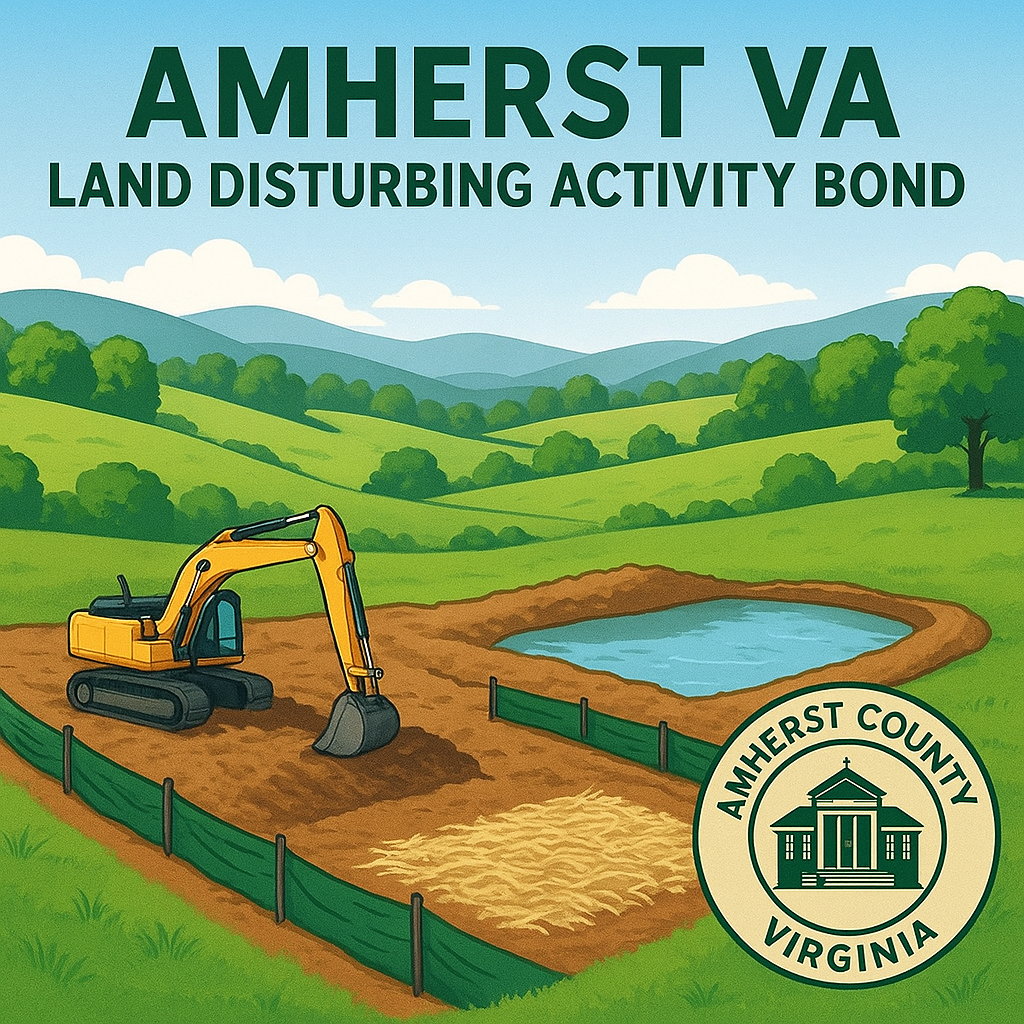
You’ve got a big project planned on your land in Amherst County. Maybe you’re clearing a lot for a new home, grading for a driveway, or starting a small commercial development. Then someone mentions you need a “land disturbing activity bond.” Your first thought might be, “What on earth is that, and why do I need one?”
Don’t worry. This isn’t a punishment or a hidden tax. Think of it more like a security deposit Mother Nature asks for—one that makes sure the soil stays where it belongs and doesn’t wash into creeks, roads, and your neighbor’s yard. In this post, we’ll break down everything you need to know about the Amherst VA land disturbing activity bond in plain, everyday language. No legal jargon, no confusing terms. Just the facts you need to get your project moving—literally.
What Exactly Is a Land Disturbing Activity Bond?
A land disturbing activity bond is a promise. Well, it’s a financial guarantee. When you get a permit to move soil—whether by digging, filling, clearing, or grading—the county wants to be sure you’ll take care of two things: controlling erosion and keeping sediment in check. If, for some reason, you don’t do that work properly, the bond steps in to cover the cost of fixing the mess.
Picture this: you rent an apartment and pay a security deposit. If you leave the place trashed, the landlord uses your deposit to clean it up. The bond works the same way. Amherst County, Virginia holds this bond as a form of insurance. If a land disturbing project leaves soil running off into a stream or sediment piling up on a public road, the county can use the bond money to hire someone to install proper erosion controls and clean things up. It protects the environment, public infrastructure, and even the property owner from bigger fines down the road.
Why Does Amherst County Require This Bond for Soil Erosion Prevention?
Amherst County is beautiful. It sits in the foothills of the Blue Ridge Mountains, with rolling hills, farmland, and waterways that feed into the James River and eventually the Chesapeake Bay. That beauty comes with a responsibility. When land gets disturbed—especially on slopes—rain can pick up loose soil and carry it away fast. Without proper controls, a harmless construction site can turn into a muddy mess that clogs streams, destroys aquatic life, and damages roads.
Virginia has strict soil erosion and sediment control laws, and places like Amherst County take them seriously. The bond isn’t just a bureaucratic hurdle. It’s a tool that makes sure developers, contractors, and even homeowners follow approved erosion control plans. If a plan says you’ll install a silt fence, a construction entrance, or a sediment trap, the bond gives the county a financial backstop to get that work done if you don’t. It’s all about prevention—keeping the red clay of central Virginia where it belongs: on your land, not in the water.
Who Needs a Land Disturbing Activity Bond in Amherst, VA?
You might be surprised how many projects fall under the land disturbance umbrella. Generally, if you plan to clear, grade, excavate, fill, or otherwise change the natural ground cover on a piece of land, you could need a permit—and that permit might trigger a bond requirement. Typical examples include:
- Building a new single-family home on a slope or larger lot.
- Clearing land for farming, a garden center, or a small commercial lot.
- Installing a septic system and drain field that requires heavy regrading.
- Constructing a subdivision, road, or commercial development.
- Creating a pond or expanding a driveway with significant cut-and-fill work.
In many Virginia localities, the threshold is often disturbing 10,000 square feet or more of land. Some environmentally sensitive areas might have an even lower threshold, like 2,500 square feet. The Amherst County planning or community development office will tell you for sure based on your specific site plan. Even if you’re not a big developer, a single lot in a hilly area can easily cross that line. So if you’re breaking ground, it’s always worth a phone call to check.
How Does the Bond Actually Work?
There are three parties in any surety bond: the obligee (Amherst County), the principal (you, the property owner or contractor), and the surety (the company that issues the bond). When you get the bond, you’re entering into an agreement that says you’ll follow all local soil erosion and sediment control regulations and complete the required stabilization measures.
If your project wraps up and the county inspects the site, finding everything in order—silt fences removed, ground stabilized, no off-site sediment—the bond is released. Hooray! You get your financial obligation back, or the bond simply expires without a claim. But if inspectors find muddy runoff in the street, a failed silt fence, or bare soil left exposed for months, they’ll give you a chance to fix it. If you don’t, the county can call the bond. That means the surety pays the county a set amount to hire a contractor to do the cleanup work. Then, you owe the surety that full amount. It’s not free insurance for you; it’s a line of credit with consequences if you drop the ball.
How Much Does an Amherst VA Land Disturbing Activity Bond Cost?
There’s no one-size-fits-all price tag. The bond amount is determined by the county based on the scale of your project and the potential environmental risk. A small homeowner project might need a bond of $5,000 to $15,000, while a larger subdivision could require a bond in the hundreds of thousands of dollars. Don’t let that number scare you, because you don’t pay that full amount upfront.
You pay a premium, which is a small percentage of the total bond. For most applicants with decent credit, the premium can range from 1% to 5% of the bond amount. So if your bond is $10,000, your out-of-pocket cost might only be $100 to $500 for a one-year term. Some bonds are written for the duration of the project, and you may need to renew them annually if the work takes longer than expected. It’s an affordable way to show the county you’re serious about responsible land management.
Steps to Get Your Bond and Start Your Project
Ready to move forward? The process is straightforward, especially if you work with a surety bond agency that understands Virginia’s land disturbance rules. Here’s a typical roadmap:
- Visit the Amherst County Community Development Office. They’ll tell you if a land disturbance permit is required and what bond amount they’ll need.
- Prepare an erosion and sediment control plan. Most projects need a plan stamped by a professional engineer or certified plan designer. This shows how you’ll keep soil in place.
- Contact a surety bond provider. Provide basic info about your project, your credit history, and the bond amount required. The agency will shop rates to get you the best premium.
- Pay the premium and receive your bond form. The surety will issue the official bond document.
- File the bond with the county. Turn in the original bond along with your permit application or before the permit is issued.
- Start work—but stay compliant. Keep those erosion controls in good shape and call for inspections as the project proceeds.
The whole bonding process can take as little as a day if you have your paperwork in order. Many agencies even offer online applications, so you don’t have to leave your job site.
What Happens If You Skip the Bond or Violate the Rules?
Ignoring the bond requirement is not a smart shortcut. Operating without a required permit and bond in Amherst County can lead to a stop-work order, daily fines, and even legal action. If a violation causes sediment to reach a stream or wetland, state agencies like the Virginia Department of Environmental Quality can get involved, bringing much steeper penalties. You could also be held liable for damage to neighboring properties. The bond is there to protect you from these expensive headaches, not to cause them.
Simple Tips for a Smooth Experience
Nobody wants delays or unexpected costs. A few proactive moves can make the bond process nearly invisible:
- Plan ahead. Don’t wait until the week you want to start digging to look into permits and bonds.
- Hire contractors who know erosion control. They’ll already have experience installing silt fences, construction entrances, and seed/straw mulch in ways that pass inspection.
- Keep the site clean. After a rainstorm, walk the perimeter. Look for signs of runoff and fix small issues before they become county-sized problems.
- Document everything. Take photos of your controls when they’re fresh and after rain events. It’s your proof of good faith if questions arise.
Why This Bond Is Good for Everyone
It’s easy to see a mandatory bond as just another item on a long to-do list. But think about what it achieves. Clean creeks and rivers aren’t just nice to look at—they’re essential for drinking water, recreation, and wildlife. A site that manages erosion well also preserves your topsoil, keeps your foundation stable, and avoids ugly ruts that lower property value. The Amherst VA land disturbing activity bond aligns your project with community values. You get to build what you need, and the county gets to keep its natural resources protected for everyone.
So next time someone tells you that you need one of these bonds, you can smile, knowing exactly what it is and how easy it can be. A little paperwork and a small premium unlock your project while keeping Virginia’s soil and water safe. And that’s a deal worth digging into.