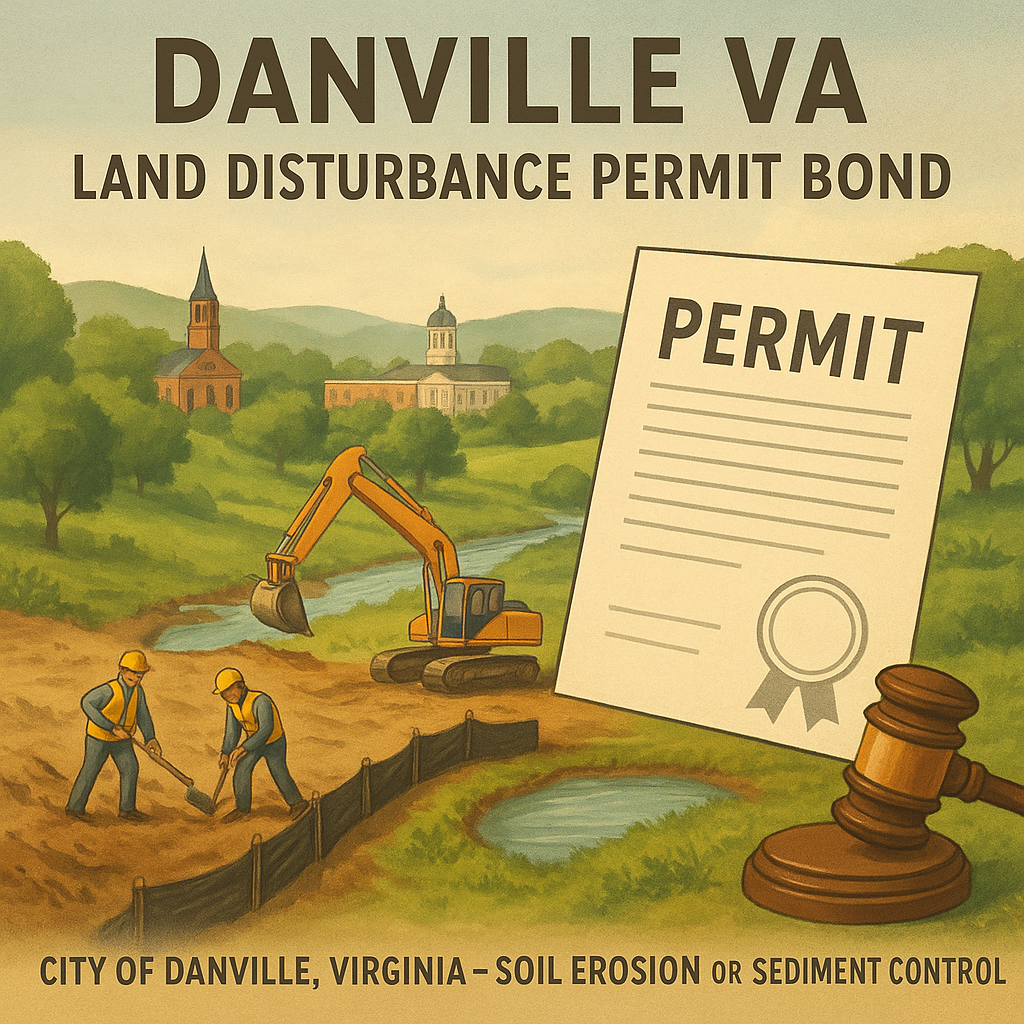
If you’ve ever watched a construction site transform raw land into a new neighborhood or shopping center, you’ve probably noticed those black silt fences and straw-covered slopes. They aren’t just decoration—they’re a critical part of keeping our rivers clean and our soil where it belongs. If you’re planning a project that disturbs the ground in the City of Danville, Virginia, you’ll quickly bump into something called a Land Disturbance Permit Bond. It might sound like bureaucratic red tape, but it’s really a promise between you, the city, and the environment. Let’s unpack what that means in plain English.
What Exactly Is a Land Disturbance Permit Bond in Danville?
Think of a land disturbance permit bond as a financial safety net. Whenever you move dirt on a large enough scale—grading a lot, digging foundations, or clearing land for a new road—the City of Danville wants to make sure the exposed soil doesn’t just wash into the nearest stream when it rains. The bond is a guarantee that you’ll install and maintain proper erosion and sediment controls. If you don’t, the city can step in, fix the problem, and use the bond money to pay for it. It’s not a fine; it’s a pre-funded cleanup plan.
In Danville, this bond is required as part of your land disturbance permit application. The amount isn’t random—it’s based on the size of your project and the potential risk to nearby waterways. You won’t guess a number and write a check. The city’s erosion and sediment control staff will calculate the bond amount based on the disturbed acreage and the specific controls needed. Once that’s set, you’ll purchase a surety bond from an insurance company or bonding agency. That piece of paper tells the city, “We’ve got this covered.”
Why Soil Erosion and Sediment Control Matters So Much
You might wonder, “It’s just a little mud. What’s the big deal?” The big deal is that sediment is actually the number one pollutant in Virginia’s waterways by volume. When soil washes off a construction site, it carries fertilizers, oils, and other chemicals into streams and rivers. That murky water chokes out fish, damages aquatic plants, and even increases flooding downstream because the sediment fills up stream channels. The City of Danville, like the rest of Virginia, takes this seriously because clean water matters to everyone—from the kayaker on the Dan River to the family drinking tap water miles away.
A land disturbance permit bond directly ties your project’s responsibility to those water quality goals. If a sudden rainstorm washes out a poorly installed silt fence and mud flows into a creek, the bond ensures there’s money available to correct the problem immediately, without waiting for a court order or a lengthy enforcement process. It’s a practical tool that puts real teeth into environmental rules.
How the Bond Fits Into Your Danville Permit Process
Navigating a permit can feel like learning a new language. Let’s break the steps down so you know exactly when the bond comes into play.
First, you submit a land disturbance permit application to the City of Danville’s Community Development department. You’ll include an erosion and sediment control plan drawn up by a qualified professional. That plan shows exactly how you’ll manage stormwater, where silt fences go, what kind of stabilized construction entrance you’ll use, and how you’ll temporarily or permanently seed the site. The city reviews the plan and, if it meets Virginia’s Erosion and Sediment Control Law and Danville’s ordinances, they’ll approve it.
Next comes the bond. After the plan is approved, the city calculates the necessary bond amount. You’ll then go to a surety company to obtain the bond. This isn’t like insurance where you pay a premium and get coverage for your own losses. A surety bond is a three-party agreement: you (the principal), the city (the obligee), and the bonding company (the surety). You pay a percentage of the bond amount—often 1-15% depending on your credit—and the surety issues the bond. If you fail to hold up your end of the bargain, the surety pays the city, then comes after you for reimbursement. So it’s not a free pass; it’s a credit-based guarantee.
Finally, you present the bond to the city, pay any remaining permit fees, and your land disturbance permit is issued. Only then can you legally start moving dirt.
Common Misconceptions That Can Trip You Up
Let’s clear up a few things that often confuse folks new to the process. Some people think the bond is a one-time tax or a fee that goes into the city’s general fund. Not true. The bond is held until the project is complete and the ground is permanently stabilized. Once your site passes final inspection—meaning grass is growing, slopes are protected, and all temporary controls are removed—you can request a release of the bond. If you’ve done everything right, the bond goes back to the surety and your obligation ends. You don’t get the premium you paid back, but that’s the cost of doing business.
Another misconception: “My contractor will handle everything.” While your contractor will likely install the erosion controls, the permit and bond are typically the responsibility of the property owner or the developer. You can’t delegate the ultimate legal responsibility. If the contractor walks off the job and leaves a mess, the bond is still tied to you. A smart move is to make sure your contract with any builder clearly spells out who pays for the bond, who maintains controls, and who takes care of final stabilization.
What Happens If You Skip the Bond or Let Erosion Controls Fail?
Ignoring this requirement isn’t a minor oversight—it can stop your project in its tracks. The city has the authority to issue a stop-work order if you start land disturbance without a valid permit and bond. They can also levy fines that accumulate daily. Beyond the financial hit, there’s the damage to your reputation. A neighborhood that sees muddy runoff pouring from your site won’t smile on you. And if the discharge reaches a stream, you could face enforcement from the Virginia Department of Environmental Quality as well.
On the flip side, a well-managed site with properly maintained controls is something to be proud of. Neighbors appreciate watching a project that stays clean. Your crew works on a drier, safer site. And you avoid costly delays. It’s a classic case where an ounce of prevention is worth a pound of cure.
Practical Tips for a Smooth Bonding Experience
Ready to get started? Here are a few things that can make the journey easier.
- Work with a bonding agency that understands Virginia’s local requirements. Not all surety agents know the ins and outs of a Danville land disturbance permit bond. Look for an agent who routinely handles site improvement bonds or subdivision bonds.
- Have your erosion and sediment control plan ready before you shop for a bond. The bond amount is tied to that plan, so you’ll need the approved document. Nothing slows things down like going back and forth between the city, the surety, and your engineer.
- Check your credit score early. Since the bond premium is credit-based, fixing any errors on your report before applying can save you money. A small dent in your score can mean a significantly higher premium.
- Don’t skimp on ongoing maintenance. The cheapest way to avoid a bond claim is to assign someone to inspect the site after every rainstorm. A quick repair to a silt fence or a fresh application of straw is far cheaper than dealing with cleanup costs and a drawn-out claim.
- Keep good records. Take dated photos of your controls when they’re first installed and after each maintenance visit. If a dispute arises, you’ll have proof you were diligent.
How Does Danville’s Bond Compare to Other Virginia Cities?
You might be curious if Danville is particularly strict. The truth is, the legal foundation comes from the Virginia Erosion and Sediment Control Law, so the framework is consistent statewide. What varies from locality to locality is how the bond amount is calculated and when it’s released. Danville tends to be development-friendly while still holding firm on environmental protection. The city staff are generally willing to meet with you before you submit your application to answer questions—a step that can save weeks of back-and-forth.
If you’ve done work in nearby Lynchburg or South Boston, you’ll find Danville’s process familiar. The key difference is always in the local details: which department handles the permits, what forms they need, and their specific inspection timelines. A quick call to Danville’s Community Development office can clarify any questions that aren’t covered on their website.
When Does the Bond Go Away? The Release Process
Let’s fast forward to the happy ending. Your project is built, the sod is down, and all the permanent drainage features are working. You’ll contact the city to schedule a final stabilization inspection. The inspector walks the site to make sure there’s no exposed soil, no rills or gullies forming, and that all temporary controls have been removed (no more orphaned silt fence flapping in the breeze). Once you get the green light, you submit a bond release request to the city. They’ll verify everything is in order and notify the surety company. The bond is then canceled, and that liability is off your plate. It’s a satisfying moment—your little patch of Danville is now a stable, stormwater-compliant piece of the community.
Some projects may qualify for a partial release if a phase is complete while other areas are still under construction. Ask about this option upfront if your job is phased. It can free up bonding capacity for future work.
What’s the Real Cost of Doing the Right Thing?
Let’s talk dollars and sense. The bond premium is a direct expense, but consider the alternative. A single violation can bring fines, legal fees, remedial cleanup costs, and project delays that dwarf the cost of the bond. Not to mention the potential for lawsuits if your sediment damages a neighbor’s property. When you look at the bond as a form of project insurance, the math becomes clear. And good erosion control practices often lead to better site conditions, which means fewer rain delays for your crew. It’s not just about compliance; it’s about running a smarter, more profitable job.
Are you ready to break ground in Danville? Understanding the land disturbance permit bond is your first step toward a project that respects the land, the water, and the community. Take the time to line up your paperwork, talk to a trusted surety agent, and build a relationship with the city inspectors. When you do, you’ll find that the process isn’t a hurdle—it’s part of building something that lasts. And when you see that first green grass covering a slope you once stripped bare, you’ll know the extra effort was worth it.