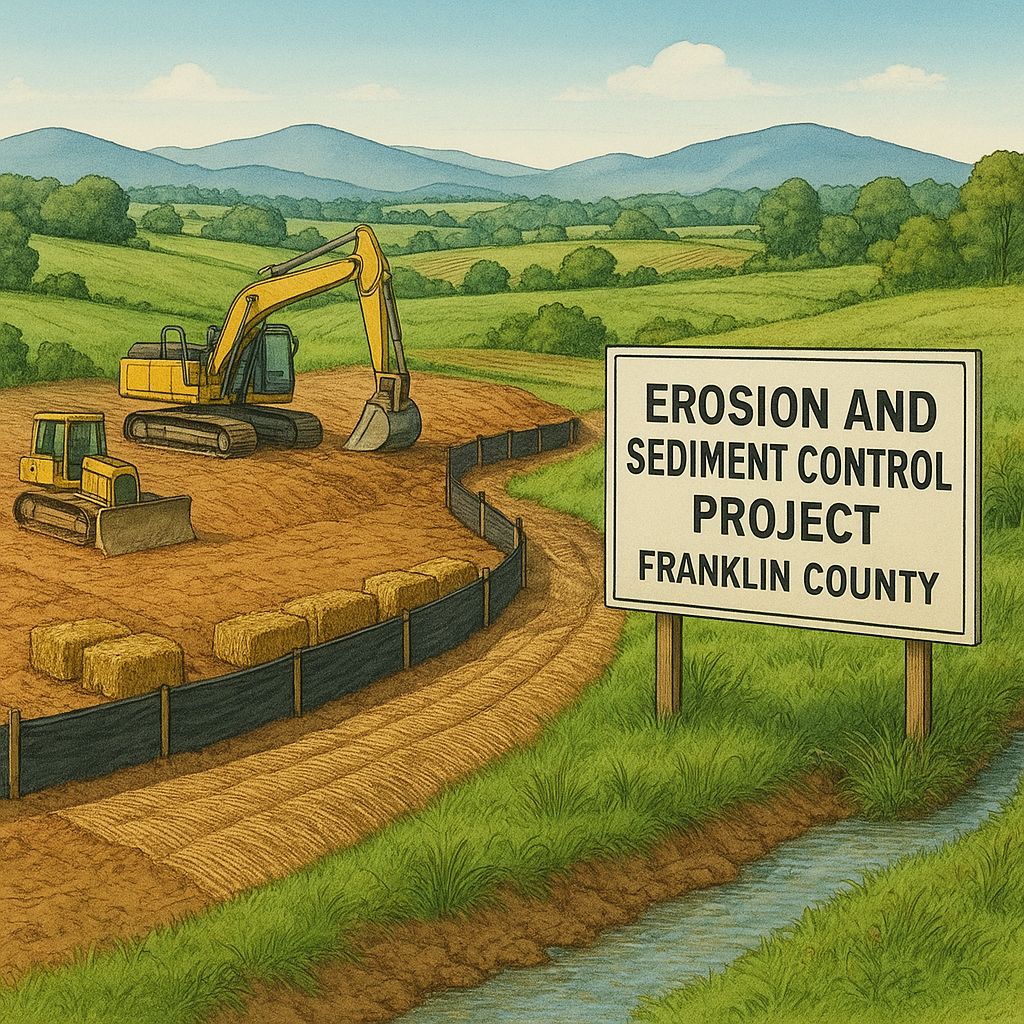
Have you ever watched a heavy rainstorm wash a trail of mud across a freshly paved driveway? It’s frustrating, messy, and expensive to fix. Now imagine that same sort of dirt and debris slipping off a construction site, a farm field, or a newly graded lot—except this time it’s heading straight for a creek, a neighbor’s property, or a public road. That’s where erosion and sediment control steps in, and here in Franklin County, Virginia, the approach is getting a fresh, forward-thinking twist that’s turning heads. Instead of just hoping builders and landowners do the right thing, the county has woven a simple financial tool into the mix: the Franklin County VA erosion and sediment control bond. It might sound like paperwork, but it’s actually a clever way to protect the land we all share.
If you’re a homeowner planning a small grading project, a developer breaking ground on a subdivision, or just someone who loves seeing clear streams and healthy soil, understanding how soil erosion or sediment control works in Franklin VA can save you a lot of headaches. Let’s unpack it all in plain, everyday language—no engineering degree required.
Why All the Fuss About Dirt and Water?
At first glance, a little soil washing away doesn’t seem like a big deal. But when you zoom out, the picture changes. Erosion is nature’s way of moving soil from one place to another, and when we humans disturb the land—by clearing trees, tilling fields, or scraping earth for a foundation—we speed up that process dramatically. Each raindrop that hits bare ground can dislodge tiny particles, and before you know it, valuable topsoil is gone, and nearby waterways are choked with sediment.
Think of sediment like dust settling all over your favorite bookcase, except it’s settling into creeks, rivers, and reservoirs. It clouds the water, smothers fish habitats, fills in channels so they can’t hold as much stormwater, and often carries pollutants like fertilizers and oil along for the ride. In a county as beautiful and agriculturally rich as Franklin County, Virginia, keeping soil where it belongs isn’t just a nice-to-have—it’s an investment in farming, fishing, and the simple pleasure of clean, clear streams.
What Makes Franklin County’s Landscape Special—and Delicate
Stretching from the rolling foothills of the Blue Ridge Mountains to the shores of Smith Mountain Lake, Franklin County has a little bit of everything. You’ll find steep wooded slopes, open pastures, and growing residential pockets. That diversity is exactly why a one-size-fits-all rulebook for erosion control doesn’t always work. A hillside vineyard needs different protection than a flat commercial site near Rocky Mount. Creek crossings and lakefront lots have their own unique sensitivities.
When you sit down with local planners, they’ll tell you the same thing: good Virginia erosion and sediment control starts with reading the land. And today, Franklin County is layering that local knowledge with a system that adds accountability—without making honest folks jump through unnecessary hoops.
The Bond That’s Really a Promise
Now, let’s talk about that term you might have seen pop up in permits or contractor conversations: the Franklin County VA erosion and sediment control bond. It’s not some new tax or hidden fee. It works a lot like the security deposit you pay when you rent an apartment. You put a certain amount of money or a surety bond in place as a guarantee that you’ll follow the approved erosion and sediment control plan for your project. If everything is installed correctly—silt fences, sediment basins, stabilized entrances, mulch, seeding—and the site stays in good shape, you get that bond released. If the site turns into a mud factory that damages adjacent properties or clogs public drainage, the county can use that bond to step in and fix the problem.
What makes this strategy innovative isn’t the bond itself—bonds have existed for ages—but the way Franklin County is weaving it into a culture of responsibility. Instead of treating the bond like a punishment waiting to happen, local officials and inspectors use it as a conversation starter. They walk the site with you, explain what the land needs, and help you see the bond as a motivation to get things right the first time. It’s less “gotcha” and more “we’re in this together.”
How the Bond Process Actually Feels on the Ground
Picture this: you’re adding a detached garage on your sloping property near Penhook. Before you break ground, your site plan shows where you’ll place a gravel construction entrance and a silt fence at the bottom of the slope to catch any washed soil. The county reviews it, maybe suggests a slight tweak based on local soil types—Franklin County’s red clay can be tricky—and then issues a land-disturbing permit that includes a bond requirement. The bond amount is scaled to the size and risk of your project, so a small home project won’t face the same figure as a 50-acre subdivision. From there, you do the work, keep the controls in good shape, and after a successful final inspection and some vegetation establishment, your bond obligation disappears. Simple, transparent, and fair.
This approach takes the guesswork out of compliance. You know the expectations up front, and the county has a practical way to protect natural resources without having to chase people down after the fact. For anyone googling “Franklin VA erosion and sediment control bond,” the bottom line is that it’s a tool designed to keep your project moving and your neighbors’ streams clean.
Going Beyond the Bond: Creative Control Tactics Taking Root
Franklin County’s strategies don’t stop at financial guarantees. More and more, you’ll see contractors, farmers, and even homeowners adopting methods that work with nature rather than fighting it. Here are a few you might spot around the county:
- Vegetated buffers along streams: Instead of mowing right up to the water’s edge, leaving a strip of native grasses, shrubs, and trees acts like a natural filter. It slows runoff, traps sediment, and provides wildlife corridors. Along the Blackwater River and its tributaries, these buffers are quietly doing heavy lifting.
- Rain gardens and dry swales: Rather than funneling all stormwater into a pipe, many new developments are carving shallow depressions planted with water-loving species. They capture runoff, let it soak into the ground, and look a whole lot nicer than a concrete ditch.
- Phased grading: Instead of clearing an entire site at once, builders are learning to disturb only the area they can stabilize immediately. It sounds obvious, but in practice it takes discipline—and it drastically reduces the window of time that bare dirt is exposed to rain.
- Compost blankets and erosion control mats: On steep slopes where regular seeding might wash away, rolled erosion control blankets made of straw, coconut fiber, or compost give seedlings a cozy, protected place to take root. You’ll see these hugging roadbanks and newly shaped hillsides.
These practices aren’t just top-down regulations. Local soil and water conservation district staff often work shoulder-to-shoulder with landowners, offering technical advice and sometimes even cost-share programs. The bond requirement is the safety net; these techniques are the day-to-day habits that keep soil out of our lakes and rivers.
Real-Life Impact: Why Your Morning Commute Benefits Too
Have you ever driven down a country road after a storm and seen orange-brown water pooling at the bottom of a hill, or mud smeared across the pavement from a construction entrance? That’s sediment on the move, and it’s more than an eyesore. It can make roads slick, clog culverts, and send maintenance costs soaring. When erosion and sediment control is done right, those problems shrink. The bond system helps ensure that sites are stabilized quickly, which means fewer emergency calls to public works crews and less tax money spent on ditch cleanouts.
Even if you don’t live next to a big development, you might notice the difference in your favorite fishing spot. Smith Mountain Lake, Philpott Reservoir, and the many smaller impoundments that dot the county are all vulnerable to sediment buildup. Every particle of soil kept on the hill is one less particle settling into those treasured waters. So when someone asks, “Why should I care about some bond I’ve never heard of?” the answer is sitting in your boat and shining in your tap water.
Common Questions People Ask About Erosion Control in Franklin County
Does every single project need a bond? Not necessarily. Smaller, low-risk activities like home gardens or minor landscaping often fall below the threshold that triggers a full land-disturbing permit. But if you’re moving a significant amount of earth or opening up more than a certain acreage—typically 10,000 square feet or more, though you should always check current local ordinances—that’s your cue to talk with the county about soil erosion or sediment control requirements, including bonding.
What if I’m just fixing an existing driveway? Great question. A simple resurfacing job usually doesn’t disturb new ground, so it won’t kick off the same level of review. However, if you’re widening or adding a new asphalt pad that changes how water flows, you’ll want to have a quick conversation with the natural resources or planning department. They’d much rather give you a yes-or-no answer in five minutes than see you deal with a washout later.
Is the bond money refunded completely? If you stick to the plan and stabilize the site, yes—the bond obligation is released. It’s not a fee the county keeps as a profit center; it’s a temporary assurance. That’s a key point that often calms people’s nerves when they first hear the word “bond.”
Can an erosion control bond help me sell a property? Indirectly, absolutely. A property with a well-documented, properly closed-out erosion control plan and a released bond signals to buyers that the land was developed responsibly. It’s one less red flag during a title search or a home inspection.
Tying It All Together With a Forward-Looking Mindset
At its heart, the story of the Franklin County VA erosion and sediment control bond isn’t about bureaucracy. It’s about keeping the deep-green hillsides, clear-running creeks, and productive farmland that make this corner of Virginia so special. Whether you call it soil erosion or sediment control, Virginia erosion and sediment control, or just plain good land stewardship, the outcome is the same: safer roads, healthier waterways, and a safer bet for your property investment.
If you’re about to start a project and feeling a little lost, take a breath. Reach out to the county’s community development or natural resources staff. Ask questions early. Walk your land with someone who understands the local soils and slopes. And see that bond not as a hurdle, but as a handshake—proof that everyone has a stake in keeping Franklin County beautiful for generations to come.
Next time a storm rolls through, you can watch the rain with a little more confidence, knowing that the right strategies are at work—sometimes visible, sometimes tucked away in a permit folder—quietly holding the ground right where it belongs.