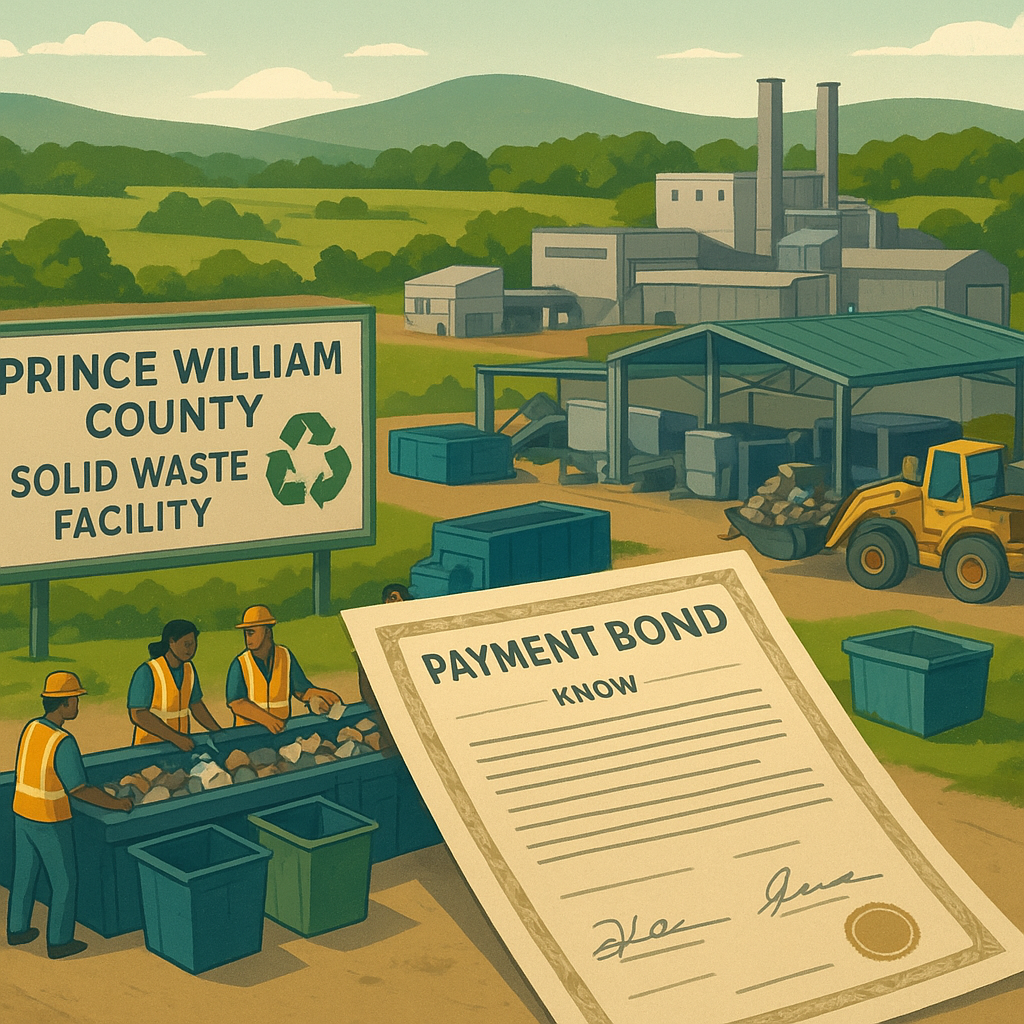
Big construction projects can feel like a puzzle. And when public money is involved, the rules of the puzzle change. If you’ve heard the term “payment bond” floating around conversations about the solid waste facility expansion in Prince William County, you’re not alone. Maybe you’re a subcontractor worried about getting paid. Or perhaps you’re a local supplier wondering how this huge refuse disposal project affects you. Let’s break it all down in plain, everyday language.
What Exactly Is a Payment Bond?
Think of a payment bond like a financial safety net. It’s a special kind of guarantee. A surety company issues it on behalf of the main contractor (the principal) to the project owner (the obligee). In this case, the project owner is Prince William County, Virginia. The bond’s big promise? If the general contractor doesn’t pay the people they hire—like subcontractors, laborers, and material suppliers—those folks can make a claim against the bond. The surety then steps in to make sure everyone gets what they’re owed, up to the bond amount.
It’s similar to a co-signer on a loan. The county doesn’t just take the general contractor’s word that everyone will be paid. The bond company, after checking out the contractor’s finances and track record, puts its own money on the line as a backup plan.
Why Prince William County Requires This Bond for the Solid Waste Facility Expansion
Public construction projects are a different breed. You can’t put a mechanic’s lien on government property. If a subcontractor doesn’t get paid for installing compactors at the refuse disposal site, they can’t just file a claim against the county’s land. That’s why federal and state laws, specifically the Virginia Little Miller Act, step in. For any state or local public project exceeding a certain dollar amount, a payment bond is mandatory. The solid waste facility expansion in Prince William County easily clears that threshold. This bond protects the community’s tax dollars and the local businesses fueling the project.
Who Benefits from the Payment Bond?
The circle of protection is wide, and that’s the point. Here’s who can breathe a little easier because of it.
Subcontractors and Tradespeople
The electricians wiring the new sorting systems, the plumbers, the HVAC crews, and the heavy equipment operators all fall under this umbrella. They are often first in line to feel financial pressure if a payment chain breaks. The bond ensures their labor doesn’t go uncompensated.
Material Suppliers
Think about the staggering amount of concrete, steel, piping, and specialized refuse handling equipment needed. Local Virginia suppliers providing those materials have a direct path to recovery if invoices go unpaid. They simply need to show the materials were delivered and used on the site.
The General Contractor (Yes, Really)
This might sound odd, but requiring a bond actually helps the reputable general contractor too. It prequalifies them. By securing a bond, they signal to Prince William County and the public that a surety company has already vetted their financial strength and integrity. That reputation is gold when bidding on future projects.
How Does a Payment Bond Differ from a Performance Bond?
These two get mixed up all the time, so let’s clear the air. They’re often issued together, but they solve different problems. A payment bond protects the people. A performance bond protects the project itself. If the contractor goes bankrupt or simply abandons the solid waste facility expansion, the performance bond guarantees the county has funds to hire someone else to finish the job. The payment bond, on the other hand, is entirely focused on making sure the workers and suppliers get their money. Both are crucial, but today we’re shining a spotlight on the financial fuel that keeps the workforce strong.
The Step-by-Step Process of Making a Claim
Nobody wants to make a claim, but knowing the path is power. Let’s say a Virginia-based steel fabricator provides beams for the refuse disposal building and doesn’t get paid after 60 days. What happens next?
First, understand the clock. The Virginia Little Miller Act has strict deadlines. A claimant who has no direct contract with the general contractor (a second-tier supplier, for instance) must send a preliminary notice to the general contractor within 60 days of their last delivery or work. This is a “heads up, we’re here and we haven’t been paid” letter. Missing this notice can kill a claim entirely.
After that, the formal claim goes to the surety company named on the bond. The claimant must provide detailed documentation: invoices, delivery receipts, and proof that the labor or materials went specifically into the Prince William County solid waste facility expansion. The surety investigates, and if the claim is valid, they pay it. The surety then turns to the general contractor to get repaid, using the contractor’s company and often personal assets as collateral.
What Does a Payment Bond Cost?
The premium—the price the contractor pays for this bond—is generally a small percentage of the total contract amount. For a project as massive as a county solid waste facility, the contract value is significant, but the rate usually falls between 0.5% and 3% of that total. Where a contractor lands on that scale depends on a few things.
Credit score is a heavyweight factor. A strong business and personal credit history pushes the rate down. Company financials matter immensely. The surety will dig through balance sheets, cash flow statements, and work-in-progress reports to gauge the company’s health. The size and complexity of the project itself also play a role. Managing a specialized refuse disposal expansion requires a proven track record. A well-established contractor with solid finances might pay only 1%, while a newer firm or one with a few credit dings could pay closer to 3%. That cost is then built into the bid submitted to Prince William County.
Common Questions from Local Businesses
We hear a lot of the same concerns from small and medium-sized businesses in Virginia. Let’s tackle a couple.
“I’m a tiny hauling company looking to supply trucks to the site. Can I really stake a claim on a multi-million dollar bond?” Absolutely. That’s the very purpose of the bond. It’s not about the size of your company; it’s about the validity of your work. If you rented or delivered compliant refuse trucks and didn’t get paid, the bond is your legal avenue. Don’t let the scale intimidate you.
“What if the general contractor pays their direct subcontractors, but the sub doesn’t pay me?” This is a classic pain point. The legal term is “remote claimant.” You still have rights under the payment bond, but you absolutely must send that preliminary notice within 60 days. This notice requirement is the lifeline for suppliers and sub-subcontractors who don’t have a direct contract with the general contractor. Keep meticulous records of every single load delivered to the Prince William County site.
Why All This Matters for Prince William County’s Future
This facility expansion isn’t just about managing more tons of refuse. It’s about sustainable community growth. The payment bond creates a ripple effect of stability. It ensures that local Virginia businesses are willing to take on public work without fear of catastrophic non-payment. That competition leads to better pricing and innovation for the county. When the financial ecosystem around a project is healthy, the project itself gets built faster, with fewer disruptions and liens. In the end, the county gets a state-of-the-art solid waste facility, local workers pay their bills, and the tax dollars funding the project are shielded from messes they were never designed to clean up.
Navigating the Bonding Process as a Contractor
If you’re a general contractor eyeing the refuse disposal project or any subsequent expansions, preparation is your best friend. Start building a relationship with a surety bond professional now, not the week bids are due. Have your financial paperwork organized and honest. An accountant who understands construction accounting can be a secret weapon. The surety underwriter wants to see that you have the horsepower to manage the cash flow of a large, long-term project. They’re essentially betting on your success. Demonstrate that you manage risk well, can handle the scope of a solid waste facility, and you’ll secure the bond at a competitive rate. This sets you apart in a crowded bidding environment.
So, the next time the words “Prince William County Solid Waste Facility Payment Bond” pop up in a contract or a news article, you’ll see more than red tape. You’ll see a carefully designed system of trust, protecting the backbone of a project that quite literally deals with the community’s garbage. And that’s a beautiful thing, in its own way.