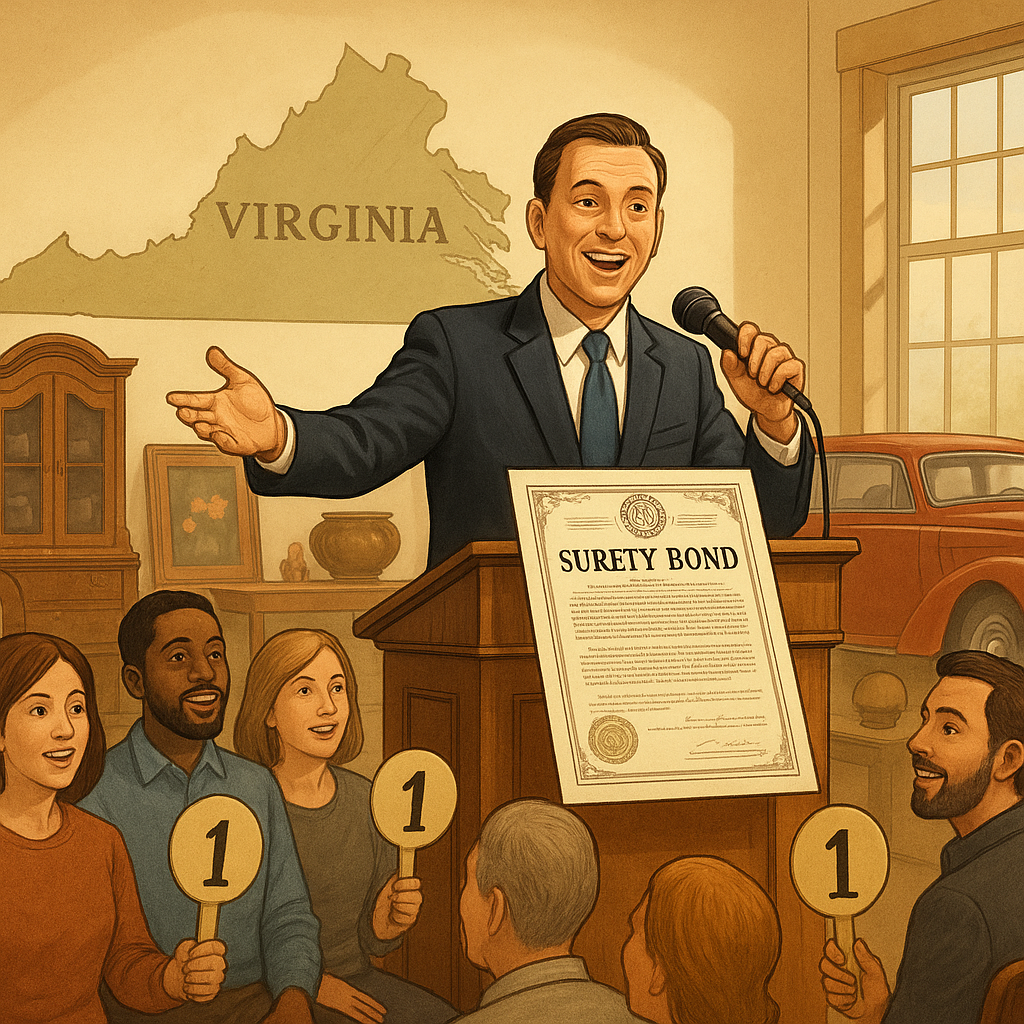
Have you ever wondered what stands between a successful auction and a financial disaster? If you are an auctioneer in Virginia—or thinking about becoming one—you might have heard about something called a “surety bond.” It sounds official and maybe even a little intimidating, but it is actually a straightforward requirement designed to protect everyone involved. Whether you are selling antiques, estate items, heavy equipment, or collectibles, understanding your Virginia auctioneer bond is a critical step in your professional journey. Let’s walk through everything you need to know, no confusing jargon attached.
What Exactly Is a Surety Bond, Anyway?
Think of a surety bond as a promise wrapped in a financial safety net. It is a three-party agreement that guarantees you will follow the rules. The three parties are the principal (that is you, the auctioneer), the obligee (the Commonwealth of Virginia, who requires the bond), and the surety (the company that backs your promise financially).
If you do your job honestly and follow Virginia’s auction laws, the bond sits quietly in the background and you never have to think about it. But if something goes wrong—say, a seller is not paid for their merchandise or a buyer is misled—the bond provides a way for that person to recover their losses. It is not insurance for you; it is a protection for the public and the state. And yes, if a claim is paid out, you are ultimately responsible for reimbursing the surety company.
Why Virginia Requires Auctioneers to Be Bonded
Virginia is serious about consumer protection, and the auction industry handles a lot of other people’s money and valuable property. The Commonwealth of Virginia, through the Department of Professional and Occupational Regulation (DPOR) and the Auctioneers Board, requires most auctioneers to file a specific bond before they can get or renew their license. This requirement serves as a layer of accountability.
By posting a bond, you are telling the state—and your clients—that you stand behind your work. It shows that you are financially reliable and committed to operating within the law. It also levels the playing field. Every licensed auctioneer has to meet the same standard, which helps build trust in the entire profession. If you are wondering, “Do I really need this if I run a small, honest business?” the answer is a clear yes. In Virginia, a Virginia Auctioneer Form Surety Bond is mandatory for auctioneers who do not deal primarily in livestock.
Who Needs the “Auctioneers (Other Than Livestock)” Bond?
Virginia makes a thoughtful distinction between different types of auction professionals. Livestock auctioneers fall under a separate category with its own bonding rules. But if your auction business involves estate sales, benefit auctions, government surplus, fine art, automobiles, equipment, or virtually anything else that is not livestock, you will need the Commonwealth of VA Auctioneer Form Surety Bond.
This applies to both new applicants and those renewing their license. The bond is issued on a specific form provided by the state, so it is crucial to work with a surety company that understands this paperwork. You cannot just submit any generic bond; it has to be the exact form accepted by the DPOR. This ensures the coverage terms match Virginia’s legal requirements precisely.
What Does the Bond Actually Cover?
The bond is designed to protect consumers—sellers, buyers, and the state—from financial harm caused by fraudulent or unethical practices. That could include things like failing to remit proceeds from a sale, misrepresenting items, breaking contract terms, or violating any provision of the Virginia Auctioneers Act. It does not cover ordinary business disputes that are not tied to a legal violation, but it provides a crucial safety valve when the rules are broken.
How Much Does This Bond Cost? (It Is Probably Cheaper Than You Think)
When people hear the word “bond,” they sometimes picture a huge upfront payment equal to the full bond amount. Fortunately, that is not how it works. The required bond amount for Virginia auctioneers is $10,000. That is the total coverage limit, not the price you pay out of pocket.
You pay a small percentage of that amount, known as the premium. For most applicants, the premium ranges from just 1% to 5% of the $10,000 total—meaning you could pay as little as $100 a year, depending on your personal credit and financial history. If your credit score is solid, you will land on the lower end. Even if your credit has some bumps, you can still typically get bonded, though the rate might be a bit higher. The key is to shop around and work with a bonding agency that specializes in auctioneer bonds for Virginia.
A Quick Comparison to Make It Clear
Think of the bond premium like an insurance premium. You are not paying $10,000 upfront. You are paying an annual fee that keeps the $10,000 protection active. Over time, if you renew your bond each year, you simply pay that smaller premium again, much like renewing a policy. It is an affordable line item in your business budget that unlocks your ability to operate legally.
How to Get Your Virginia Auctioneer Bond in Just a Few Steps
Securing your bond does not have to be a headache. The process is typically fast, and many agencies can issue your bond the same day you apply. Here is the typical roadmap:
- Gather your information: You will need your business name, license number (if renewing), Social Security number, and basic contact details.
- Choose a reputable surety bond provider: Look for an agency that writes bonds in Virginia and is familiar with the Commonwealth of Virginia Auctioneer Form.
- Apply online or over the phone: You will fill out a short application. The bonding company will run a soft credit check, which typically does not affect your score.
- Receive your quote: Within minutes, you will see your premium. If you accept, make the payment.
- Get your bond form: The surety will issue the official form, often electronically. You then sign as principal and file it with the DPOR along with your license application or renewal.
Make sure the bond is filed correctly the first time. Any error in the obligee name or bond amount can lead to a rejection from the board. That is another reason to work with a bonding specialist who knows Virginia’s specific requirements.
What Happens If Someone Files a Claim Against Your Bond?
Let’s address the elephant in the room. A bond claim can feel scary, but understanding the mechanics helps you prevent problems before they start. If a client believes they have suffered a financial loss due to your violation of the auction laws, they can file a claim against your Virginia auctioneer form surety bond.
The surety company will investigate. If the claim is valid, the surety may pay out up to the $10,000 penalty of the bond. Here is the critical part: you are legally required to pay back every penny the surety paid, plus any associated costs. In essence, the surety acts as a line of credit that you must repay. That is why operating with integrity and clear contracts is your best defense. A claim can also make it harder and more expensive to get bonded in the future. Avoiding claims is not just about following the law; it is about protecting your business reputation and financial health.
Renewing Your Bond and Staying Compliant
A surety bond is not a one-and-done task. Most Virginia auctioneer bonds are issued with a one-year term that must be renewed annually. You will want to track your expiration date carefully because letting your bond lapse can jeopardize your auctioneer license. The DPOR requires continuous coverage, so even a short gap can lead to enforcement action or a suspended license.
Many bonding agencies offer automatic renewal reminders, and some even provide an option to prepay for multiple years if you want one less thing to think about. When renewal time comes, you can expect a similar premium, though your rate may improve if your credit has gotten better or if you maintain a clean claims history. Keeping an active, valid bond is a quiet way of showing the world that you are a professional who honors commitments.
Turning Obligation Into Opportunity
It is easy to view the bond requirement as just another bureaucratic hoop to jump through. But consider this: when a prospective client sees that you are bonded and licensed in the Commonwealth of Virginia, they instantly feel safer. They know there is a mechanism backing up your promises. In a competitive market, that extra layer of trust can be the reason someone chooses your auction company over an unlicensed competitor. It is also a signal that you take your role seriously—not just as a fast-talking seller but as a fiduciary who safeguards other people’s assets.
At the end of the day, the Commonwealth of Virginia Auctioneer Form Surety Bond is more than a requirement. It is a bridge between your professional goals and the confidence of the clients you serve. When you treat bonding as an essential part of your business foundation, you set yourself up for smoother licensing, fewer headaches, and a reputation that stands the test of time. And that is something worth bonding over.