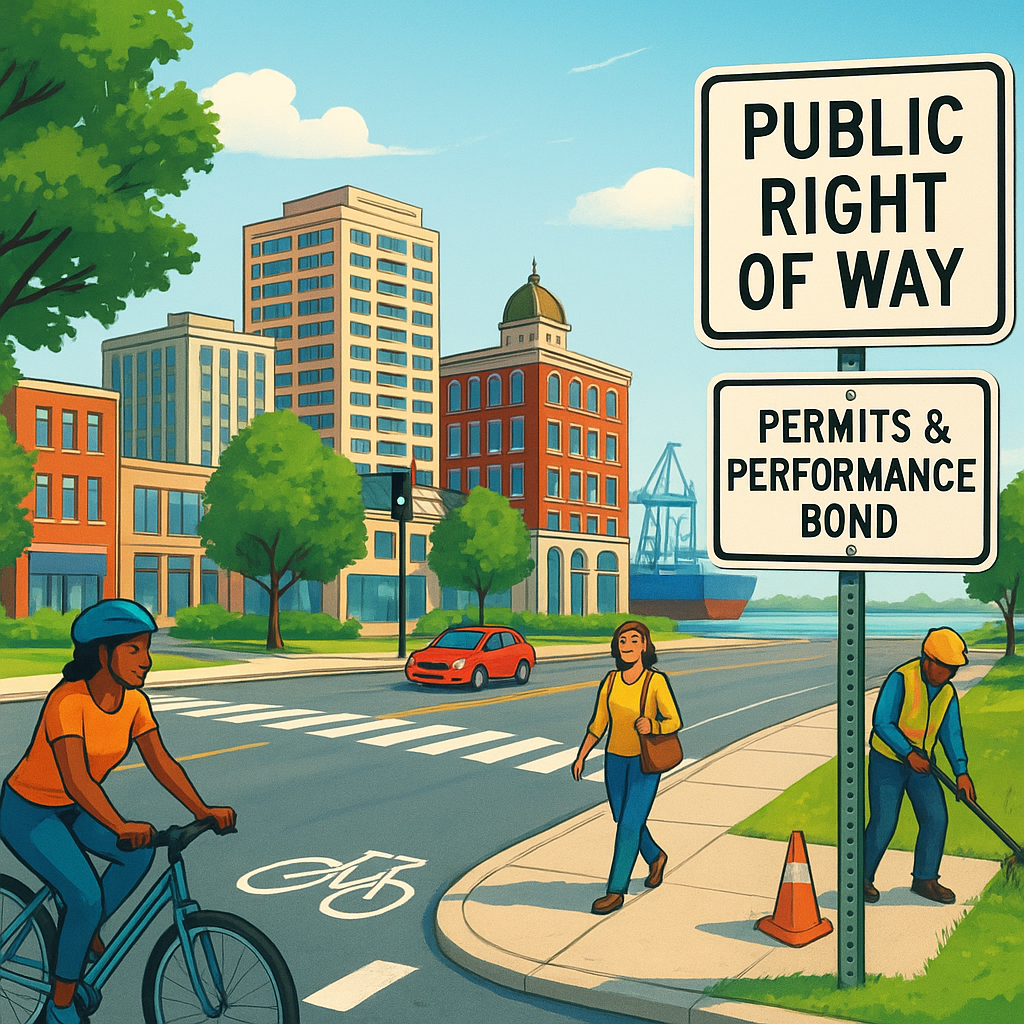
Dealing with city permits can feel like trying to solve a puzzle without the picture on the box. If you’re planning any work that touches a public sidewalk, street, or utility strip in Newport News, Virginia, you’re going to cross paths with the city’s Right of Way Permit and likely a Performance Bond. These aren’t just bureaucratic hoops; they’re safeguards designed to keep everyone safe and protect public property. But let’s break it all down into plain English so you can move forward with confidence.
What Is a Right of Way Permit, Exactly?
Think of the public right of way as the city’s front yard. It includes sidewalks, curbs, streets, alleys, and the grass strip between the sidewalk and the curb—basically any land that belongs to the city and is used for public travel or utilities. A right of way permit is the formal thumbs-up from the City of Newport News that says, “Yes, you can dig, build, or obstruct a portion of that space for a specific time and purpose.” Without that permission, any work you do is considered an encroachment and could result in fines, stop-work orders, or having to undo everything at your own expense.
So, when is this permit needed? Imagine you’re a contractor replacing a sewer line that runs under the sidewalk, a homeowner installing a new driveway apron, or a utility company laying fiber optic cables. Even placing a dumpster on the street for a renovation project typically requires a right of way permit. If your activity alters, digs into, or temporarily takes over public property, you’re squarely in permit territory.
Why Newport News Requires a Performance Bond
Now, here’s where things get a bit more serious. Getting a permit is one part of the equation; guaranteeing you’ll restore everything to its original condition is the other. That’s where the performance bond comes in. In simple terms, a performance bond is a financial promise. It tells the city, “If this permit holder doesn’t fix the street or sidewalk properly, the bonding company will pay to get it done right.”
This isn’t unique to Newport News, but the city takes the condition of its infrastructure seriously. The performance bond acts like a security deposit on a rental apartment. You promise not to trash the place, but if you do, the landlord has money set aside to cover the damages. For the city, the potential damage might be a poorly compacted trench that turns into a sinkhole six months later or a sidewalk panel that cracks after a single winter. The bond protects taxpayers from footing the bill for a contractor’s shoddy restoration work.
Who Needs a Performance Bond in Newport News?
Not every tiny project will trigger a bond requirement. Typically, the need for a bond scales with the scope of the work. Small, quick jobs—like a single residential driveway connection—might only need a permit without a bond, or they might require a cash deposit. However, larger-scale projects, especially those involving open-cut trenching across a street or extensive sidewalk replacement, will almost certainly demand a full performance bond.
You’ll often see performance bonds required for:
- Utility cuts (water, sewer, gas, electric, telecommunications)
- New curb, gutter, or sidewalk installation
- Street openings for storm drainage work
- Major landscaping that alters the public strip
- Any project where the city engineer deems the risk of future settlement or failure to be high enough to warrant a bond
How the Bond Amount Is Figured Out
You might be wondering, “How much bond will I need?” The city calculates the bond amount based on the estimated cost to restore the public right of way to its pre-work condition—or better. This includes repaving costs, concrete work, compaction testing, and sometimes an extra buffer for inflation or unforeseen conditions. If you’re trenching 100 feet across an arterial road, the restoration cost won’t be cheap, and your bond will reflect that. Often, the minimum bond amount is a few thousand dollars, but it can easily climb into five figures for extensive utility work.
Walking Through the Permit and Bond Process
The process might seem intimidating, but it’s manageable when you take it step by step. Let’s map it out so you know exactly what to expect.
Step 1: Gather Your Plans and Documents
Before you even fill out an application, you need a clear set of plans. A simple residential driveway may only require a site sketch with measurements. A utility cut will need engineering drawings showing the trench depth, width, traffic control setup, and restoration details. Have your contractor’s license and business information handy, too.
Step 2: Submit Your Application to the City
In Newport News, right of way permits are typically handled by the Department of Engineering or the Public Works department. You’ll submit your application along with your plans. At this stage, a city reviewer checks your work against local standards—things like slope requirements, paving cross-sections, and pedestrian access during construction.
Step 3: Receive Your Bond Estimate and Secure It
Once the city approves your plans, they’ll tell you the required performance bond amount. You then contact a surety company or an insurance agent who can issue the bond. The cost you pay for the bond—the premium—is a small percentage of the total bond amount, usually 1% to 3% for well-qualified applicants, though it can be higher if your credit or business finances are shaky. You’ll get a bond form that names the City of Newport News as the obligee (the party protected).
Step 4: Pay the Permit Fee and Get to Work
With the bond in hand, you pay the permit fee. Fees vary depending on the type and square footage of the work, plus any inspection fees. The city then issues your permit, which must be kept on-site. During construction, inspectors will visit to check compliance. Don’t rush the compaction or backfill—these are the most common reasons a project fails inspection and can lead to a claim against your bond.
Step 5: Pass Final Inspection and Close Out
After you’ve restored the pavement, sidewalk, or landscaping, call for a final inspection. If everything passes, the city will release or reduce your bond obligation. Some cities hold bonds for a warranty period—say one year—to ensure the patch doesn’t sink or crack. In that case, your bond stays active until the warranty period expires and a follow-up inspection confirms everything is still sound.
Common Questions People Run Into
You’re probably not the first person to wonder about these details. Let’s tackle a few questions that pop up again and again.
Can I just use a cash bond instead of a surety bond?
Sometimes, yes. For smaller projects, Newport News may accept a cash deposit, certified check, or an irrevocable letter of credit in place of a performance bond. This can be simpler if you don’t want to involve a surety company. But keep in mind your money is tied up until the project is signed off—potentially months. A surety bond keeps your cash flow healthier, though you’ll pay a premium.
What if my contractor already has bonding capacity?
If you’re a homeowner hiring a contractor, your contractor should obtain the permit and the bond in their name. Reputable contractors who do this work all the time often have a blanket bond or can pull individual bonds quickly. If a contractor asks you to pull the permit as the homeowner, be cautious—you might end up on the hook for the public restoration if something goes wrong. Always clarify that the contractor is responsible for all right of way permits and bonds.
How long does the whole process take?
For a small, straightforward project, you might get a permit within a week if your plans are clean and the bond is in order. Large-scale coordination involving traffic control plans and multiple utility agencies can take several weeks. Plan ahead and don’t leave permitting to the last minute.
Tips to Keep Your Project Headache-Free
Navigating city requirements doesn’t have to be a headache. A little preparation goes a long way. Here are a few tricks to streamline your experience.
- Call before you dig. Virginia 811 must be notified at least a few days before excavation. This is mandatory and separate from the city permit. Hitting an unmarked gas line or fiber cable is a nightmare you want to avoid, and it can trigger a claim on your bond for damages.
- Photograph everything. Before you break ground, take clear photos of the existing site—cracks in the curb, settled pavement, anything that might be blamed on your work later. Documenting pre-existing conditions gives you solid evidence if a dispute arises during the final inspection.
- Stay on top of compaction. The biggest reason bonded repairs fail is poor backfill compaction. Use proper materials and compact in lifts. If the city requires third-party compaction testing, schedule it immediately after backfill. Retesting because you rushed through this step will delay your bond release and cost extra money.
- Communicate with neighbors. A construction zone on a sidewalk or street impacts everyone nearby. A quick heads-up and some friendly signage can prevent complaints to the city that might trigger extra inspections or tighter scrutiny of your work.
Why This All Matters for Your Bottom Line
It’s tempting to view permits and bonds as just another expense. But think of them as an insurance policy against much bigger costs down the road. Without a properly managed right of way restoration, a simple sewer line repair could morph into paying for repaving an entire lane of the street if a trench failure causes a traffic accident. The bond process also levels the playing field—it ensures that contractors who cut corners on public restoration don’t gain an unfair price advantage over those who do the job right.
For homeowners, understanding this process helps you hire the right professional and avoid getting stuck with a liability you never expected. For contractors, being proactive about Newport News bonding requirements builds trust with city officials and can speed up future permit approvals. A solid track record of clean, timely restorations makes you a known quantity.
Next time you’re looking at a project that nudges past your property line, remember that the sidewalk, curb, and asphalt beyond it are part of a shared space. Treat the right of way permit and performance bond as your agreement with the community to leave that space as good as—or better than—you found it. With the right paperwork in hand and a focus on quality, you’ll keep your project moving and the city smiling.