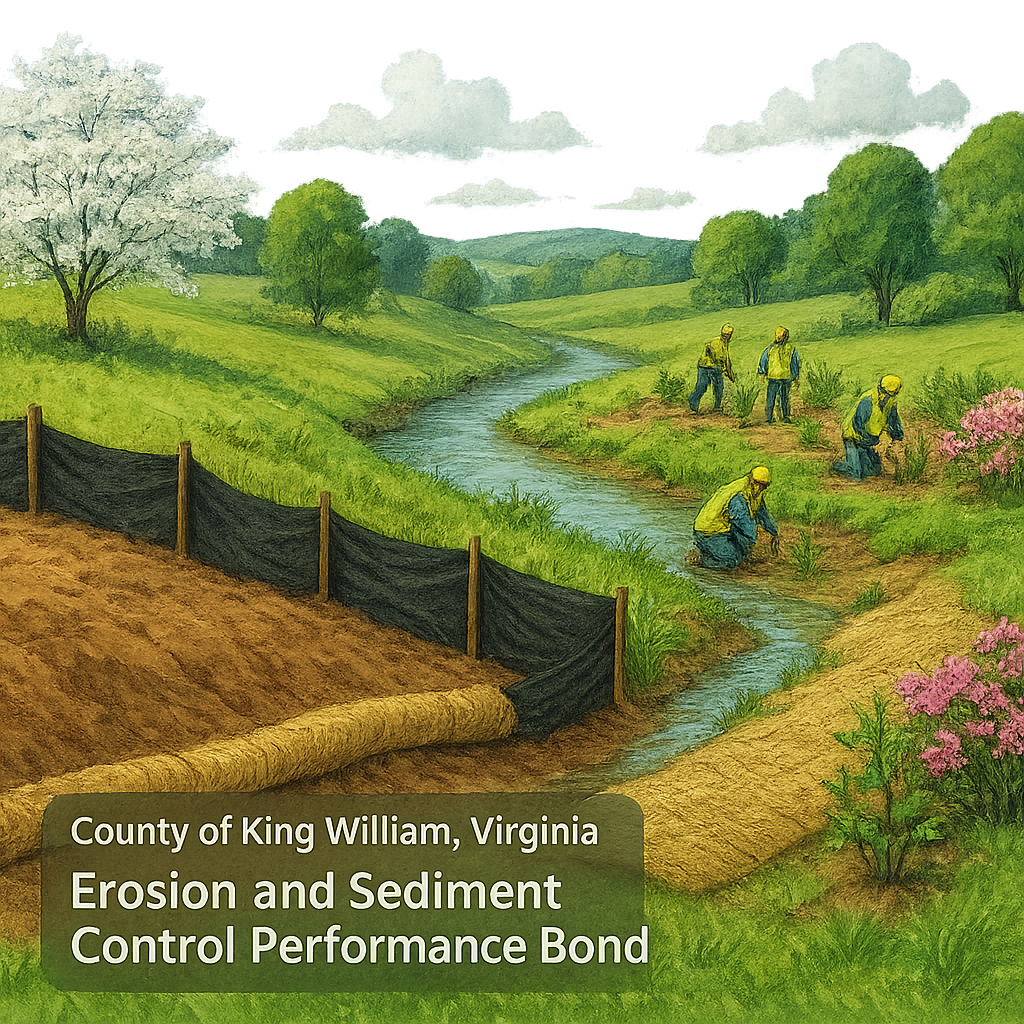
So, you’ve got a piece of land in King William County, Virginia, and you’re ready to break ground. Maybe it’s a new home, a commercial lot, or a small subdivision. You’ve lined up the excavator and marked the boundaries. Then you hear the term “erosion and sediment control performance bond” from the county permitting office. If that phrase makes your head spin a little, don’t worry. You’re not alone. Let’s walk through exactly what it means, why it matters, and how you can check this box without pulling your hair out.
What’s the Big Deal About Dirt Moving?
Picture a hard summer rain hitting a freshly cleared construction site. Without proper barriers, that rainwater turns into a muddy river, carrying soil, sand, and debris straight into the nearest stream or drainage ditch. That’s not just messy — it’s a real environmental headache. Sediment clogs waterways, harms fish, and pollutes the water that animals and people rely on.
In King William County, nestled along the Mattaponi and Pamunkey rivers, clean water is more than a talking point. It’s part of the community’s identity. That’s why the county, like the rest of Virginia, takes soil erosion and sediment control seriously. The tools used to stop that muddy runoff are known as erosion and sediment controls — things like silt fences, sediment traps, rock check dams, and seed mulching. And the county wants a guarantee that you’ll install and maintain them correctly.
Enter the Performance Bond: A Promise You Can Take to the Bank
Think of a performance bond as a three-way promise. You (the contractor or landowner) promise the county that you’ll follow your approved erosion and sediment control plan. The county wants a safety net, so a bond company steps in and says, “If they don’t keep that promise, we’ll pay to make it right.”
It’s not exactly insurance, though people often compare the two. With insurance, you pay a premium to cover your own risks. With a performance bond, you’re providing a financial guarantee to the county that protects the public and the environment. If you fail to keep the dirt where it belongs, the county can call on the bond, and the surety company will either fix the problem or pay the county to hire someone who can. Then the surety comes back to you for reimbursement. That’s the key: in the end, you’re still responsible.
Why Does King William County Specifically Require This Bond?
Virginia’s Department of Environmental Quality (DEQ) sets a baseline for erosion and sediment control programs statewide. Localities like King William County administer these rules through their own ordinances. When you apply for a land-disturbing permit — typically for projects that disturb more than 10,000 square feet of soil, or something like a single-family lot that exceeds a certain threshold — you’ll need an approved erosion and sediment control plan. Along with that plan, the county will often ask for a financial guarantee, and that’s exactly where the erosion and sediment control performance bond comes in.
The bond amount is usually tied to the estimated cost of the control measures themselves. For example, if the county engineer estimates that installing and stabilizing a silt fence network, a construction entrance, and a sediment basin will run $15,000, your bond might be set right around that number. It’s not a random fee; it’s a carefully calculated figure meant to match the actual cost of keeping the site in compliance.
Who Needs One of These Bonds?
You might assume this is only for big developers with massive bulldozers. But in reality, a wide range of projects can trigger the requirement:
- A custom home builder clearing a wooded lot for a new house
- A commercial developer grading land for a retail center
- A small business owner expanding a parking lot
- A homeowner installing a large septic field that disturbs significant soil
- A road improvement or utility project run by a subcontractor
If your project falls under King William County’s land disturbance permit requirements, you’ll likely need a bond before you can even pick up a shovel. The good news? Getting bonded isn’t as complicated as it sounds once you know the steps.
How the Process Works, Step by Step
Let’s break it down into simple, actionable pieces. You don’t need a law degree to follow along.
1. Plan Approval First. Before talking to a bond provider, make sure your erosion and sediment control plan is stamped and approved by King William County’s plan reviewer. The bond amount will be based on that plan, so you need the plan finalized.
2. Gather Your Figures. The county will tell you the required bond amount. This number represents the cost to install and maintain the controls if you, for whatever reason, can’t or won’t finish the job. Keep in mind, the bond amount might also cover things like final site stabilization.
3. Contact a Surety Bond Agent. You’ll work with a surety company or an insurance agent who specializes in bonds. They’ll ask about your credit history, business stability, and perhaps your experience with similar projects. If you’re a homeowner or a small contractor, don’t panic — small bonds are often easier to get, and the underwriting is lighter.
4. Pay the Premium. You won’t have to fork over the entire bond amount. Instead, you pay a small percentage, typically between 1% and 3% for strong credit applicants. So on a $15,000 bond, you might pay as little as $150 to $450. That premium is a one-time cost for the bond’s term, though the bond may need to stay in force until the county releases it.
5. Submit the Bond to the County. Once you have the bond document, you’ll deliver it to the permitting office. This satisfies the financial guarantee requirement, and your permit can be issued.
6. Keep Your Controls in Place. The bond doesn’t expire the moment you finish grading. It usually remains in effect until the county inspects the site and confirms that vegetation has taken hold and the area is stable. That may take months after the final grading. Only then will the county release or cancel the bond.
What Happens If Something Goes Wrong?
Life on a construction site is unpredictable. A sudden storm could wash out a silt fence, or a subcontractor might not follow the plan. The county doesn’t want to be the bad guy, but it has the authority to step in if erosion isn’t being controlled. They’ll notify you and give you a chance to fix it. If the problems aren’t corrected, the county can make a claim on the bond. The surety then investigates. If the claim is valid, the surety pays the county up to the bond amount, and the county uses that money to hire someone else to bring the site into compliance. Then you, as the bonded party, must repay the surety. Simple as that — and that’s why keeping your promises matters.
The Real-World Impact: More Than Just Paperwork
It’s easy to view a performance bond as bureaucratic red tape. But consider the alternative. Without these bonds, a builder could start a project, let sediment clog a neighbor’s pond, and then walk away, leaving the county with the cleanup bill. Taxpayer dollars shouldn’t have to cover preventable environmental damage. The bond system puts the financial responsibility squarely where it belongs — on the person disturbing the land.
For King William County, with its rural charm and treasured waterways, this matters deeply. The Mattaponi River isn’t just pretty to look at; it’s a resource for drinking water, wildlife, and recreation. Keeping mud out of that river is a community effort, and the erosion and sediment control performance bond is a key part of that effort.
Common Questions People Ask
“How long does the bond stay active?”
Typically, until the county issues a clearance or certificate of completion. This happens after final stabilization — meaning grass or ground cover is established and the site no longer poses a sediment risk. That could be a full growing season after the final grade. Plan for at least several months, sometimes up to a year or more.
“Is a cash surety or letter of credit an option?”
Many localities, including King William County, may accept alternatives like a cash bond or an irrevocable letter of credit in lieu of a surety bond. These can tie up more of your liquid cash, though, so a surety bond often preserves your working capital. Always check with the county’s permitting department for their current accepted instruments.
“What if my credit isn’t perfect?”
Surety companies look at credit, but they also consider project experience and business financials. For smaller bonds, the underwriting is often quick and credit-sensitive rather than credit-restrictive. Some sureties offer programs specifically for first-timers or those with less-than-perfect credit. You might pay a slightly higher premium, but it’s rarely a flat denial.
“Can I bundle this with other construction bonds?”
Absolutely. If your project also requires a site development bond, a subdivision bond, or a maintenance bond, you can often work with the same surety agency to streamline the process. This can save time and might even reduce your overall paperwork burden.
Making the Process Smoother: A Few Friendly Tips
No one wakes up excited to deal with bonds. But a little preparation goes a long way:
- Talk to the county early. Ask exactly what type and amount of bond they’ll require, and whether they have a preferred bond form. This avoids last-minute surprises.
- Hire a knowledgeable bond agent. Look for an agent with experience in Virginia site work bonds. They’ll understand King William County’s expectations and can guide you to a surety that fits your profile.
- Keep your erosion plan realistic. If your engineer proposes minimal controls to save money, you might still end up bonding the same amount, but the site will be more prone to failures that trigger claims. A robust, practical plan is a win-win.
- Document everything. Take photos of installed controls before a storm hits, and keep records of any maintenance. If a claim ever arises, good documentation can help resolve it quickly.
The Bottom Line
The King William VA erosion and sediment control performance bond isn’t there to make your life difficult. It’s a tool that safeguards the county’s land and water while keeping the responsibility on the builder. By understanding what triggers the requirement, how to get bonded, and what happens after your project wraps up, you can navigate this piece of the puzzle with confidence. Think of it less as an obstacle and more as a pact with your community: you promise to handle the dirt responsibly, and a bond backs up that promise. Once the grass is green and the county gives the nod, that pact is fulfilled — and you can move on to the next adventure, with a little more knowledge in your back pocket.